
Problem-driven opening: why stagnant pockets persist
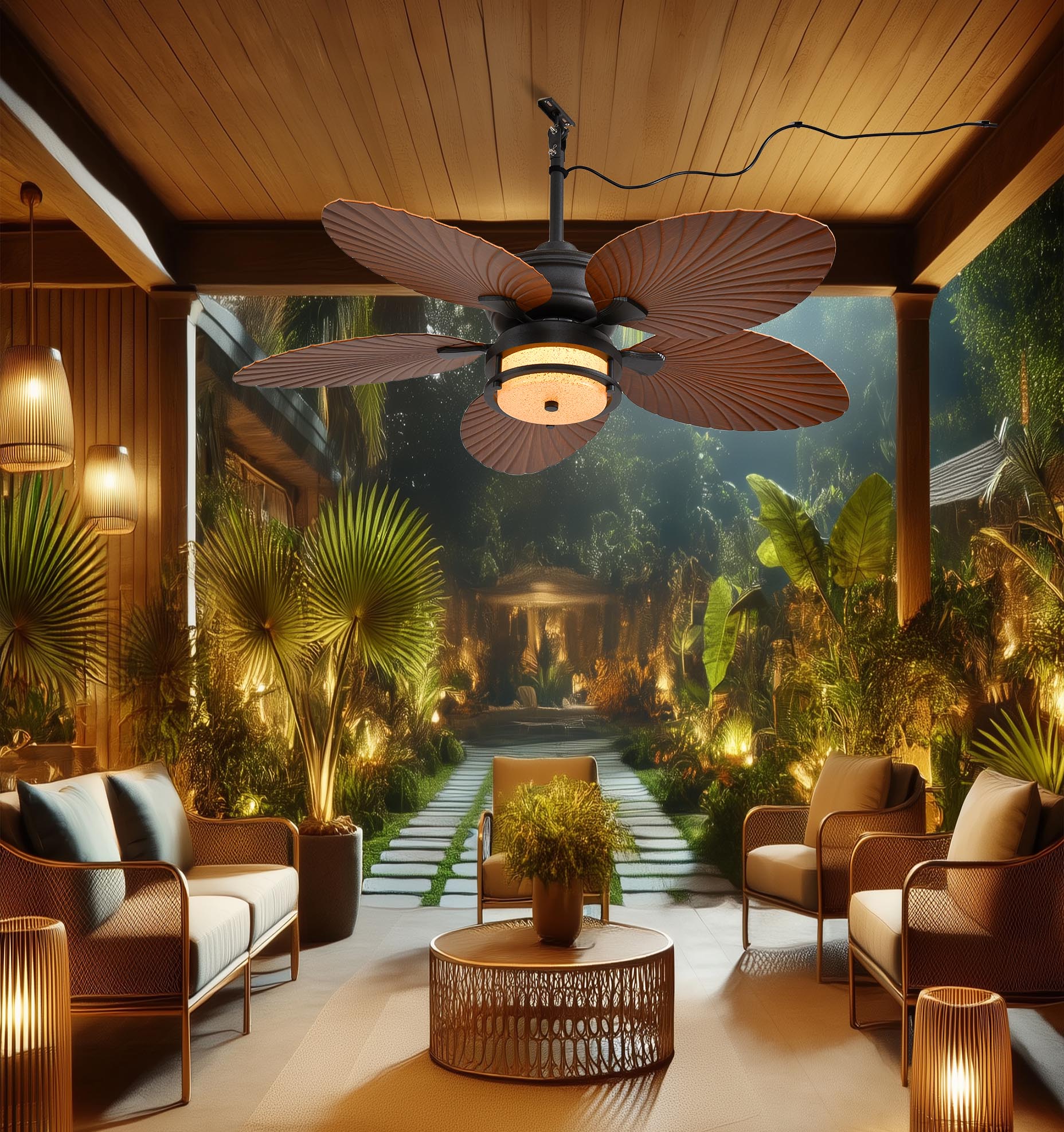
Rooms with awkward geometry — L-shaped living areas, high-ceiling foyers, or deep covered patios — commonly develop dead zones where air becomes stagnant and thermal stratification occurs. In these scenarios, a well-chosen oscillating ceiling fan with light can be a targeted remedy, providing directional airflow, supplemental cooling, and illumination without rewiring an HVAC system. For outdoor or semi-exposed spaces, consider an outdoor ceiling fan with light specified for damp or wet locations to avoid corrosion and maintain performance. The following analysis is problem-driven: we identify typical causes of stagnation, propose corrective placements and settings, and evaluate measurable outcomes so practitioners may make informed decisions.

Diagnosing dead zones: where and why they form
Dead zones are produced by a combination of layout, obstructions, and mismatched ventilation. Common contributors include:- Architectural recesses or alcoves that interrupt crossflow.- Tall furniture or partitions that block return paths.- High ceilings that trap warm air above occupied zones (stack effect).To diagnose, map occupant locations and run simple airflow checks — a smoke pencil or a sheet of tissue can reveal directional flow and recirculation patterns. Metrics to note include perceived temperature difference across the room and observable pockets of still air; in technical terms, check for inadequate air movement (low CFM relative to the occupied volume) and poor air changes per hour in the target zone.
Placement and mounting: rules that reduce stagnation
Correct fan siting is decisive. For oscillating ceiling fans, centre them where their sweep can reach the longest linear axis of the room. In L-shaped spaces place the fan at the junction of the legs if possible; its oscillation can then project air into both limbs. In rooms with tall ceilings lower the unit with an appropriate downrod to achieve a mounting height of 8–9 feet above the occupied plane — this improves perceived air movement without creating drafts. Blade pitch and diameter matter: steeper blade pitch and a larger sweep increase throughput, expressed as higher CFM at the blade tips. Also ensure electrical load and light fixture rating match local code for safety, particularly in exterior or semi-exposed installations.
Oscillation patterns and airflow dynamics
Oscillating fans deliver directional sweeps that can be tuned to disrupt stagnant eddies. Use wide-angle oscillation to sweep air across an alcove; narrow-angle, side-to-side oscillation can channel airflow along hallways or between seating groups. When pairing with an HVAC system, synchronize fan direction with supply registers to encourage lateral mixing rather than counterproductive recirculation. Practically speaking, start with low-to-medium speed to create gentle convection — this increases occupant comfort while permitting the brain to adapt to moving air without feeling gusty. Technical terms to bear in mind: CFM (cubic feet per minute), blade pitch, and oscillation arc.
Real-world anchor: a Dubai courtyard case
In an empirical installation at a courtyard villa in Dubai — a locale where summer temperatures commonly exceed 40°C and outdoor comfort is a priority — technicians combined an oscillating exterior ceiling fan with light with perimeter shade and misting controls. The fan, specified for exterior use, reduced perceived temperature by enhancing evaporation and convective cooling near seating areas. ASHRAE guidance suggests that increased air movement can improve thermal comfort, allowing higher thermostat setpoints while maintaining occupant comfort. The project demonstrated a practical result: better use of outdoor living spaces during hot months and reduced reliance on mechanical cooling in covered exterior zones.
Common mistakes and how to avoid them
Practitioners frequently make three errors: undersizing the fan relative to the area, misjudging mounting height, and failing to consider obstructions. Avoid these by:- Measuring the longest span of the room and selecting a fan sweep that projects at least to mid-span.- Positioning fans to work with, not against, existing supply or exhaust paths.- Choosing an IP-rated unit for patios and pergolas to prevent premature failure.Also, do not assume light alone solves perception of comfort — illumination helps usability but will not replace directional airflow. — A brief field test with the actual furniture layout is invaluable before final mounting.
Alternatives and complementary solutions
When ceiling mounting is impractical, wall-mounted oscillating fans or portable high-velocity units can address dead zones, though they lack integrated lighting. For exterior applications consider an exterior ceiling fan with light designed for salt-air or humid environments. Ceiling fans are most effective when used as part of a layered strategy:- Passive shading and cross-vent openings.- Spot fans for task areas.- Coordination with HVAC controls for blended comfort.Each layer reduces the burden on any single device and increases resilience to changing conditions.

Troubleshooting checklist
When performance is subpar, run this checklist:1) Verify mounting height and sweep relative to occupied zones.2) Confirm oscillation arc is unobstructed and aimed at the dead zone.3) Check blade pitch and balance; imbalance reduces effective CFM.4) Test at multiple speeds to locate the most comfortable setting.5) Ensure electrical and IP ratings match the installation environment.
Advisory close: three golden rules for effective deployment
1) Match geometry to motion: choose blade sweep and oscillation arc to reach the longest axis and any re-entrant spaces. 2) Prioritize placement over aesthetics: a slightly off-centre fan that eliminates a dead zone is better than a perfectly centred fixture that leaves pockets of still air. 3) Specify for environment: use damp- or wet-rated fixtures for semi-exposed or open-air installations and verify light fixture thermal limits to avoid premature degradation.
Applied correctly, an oscillating ceiling fan with light becomes a tactical tool for comfort, efficiency, and extended use of both interior and exterior spaces; and for integrated, durable solutions, Orison. —