
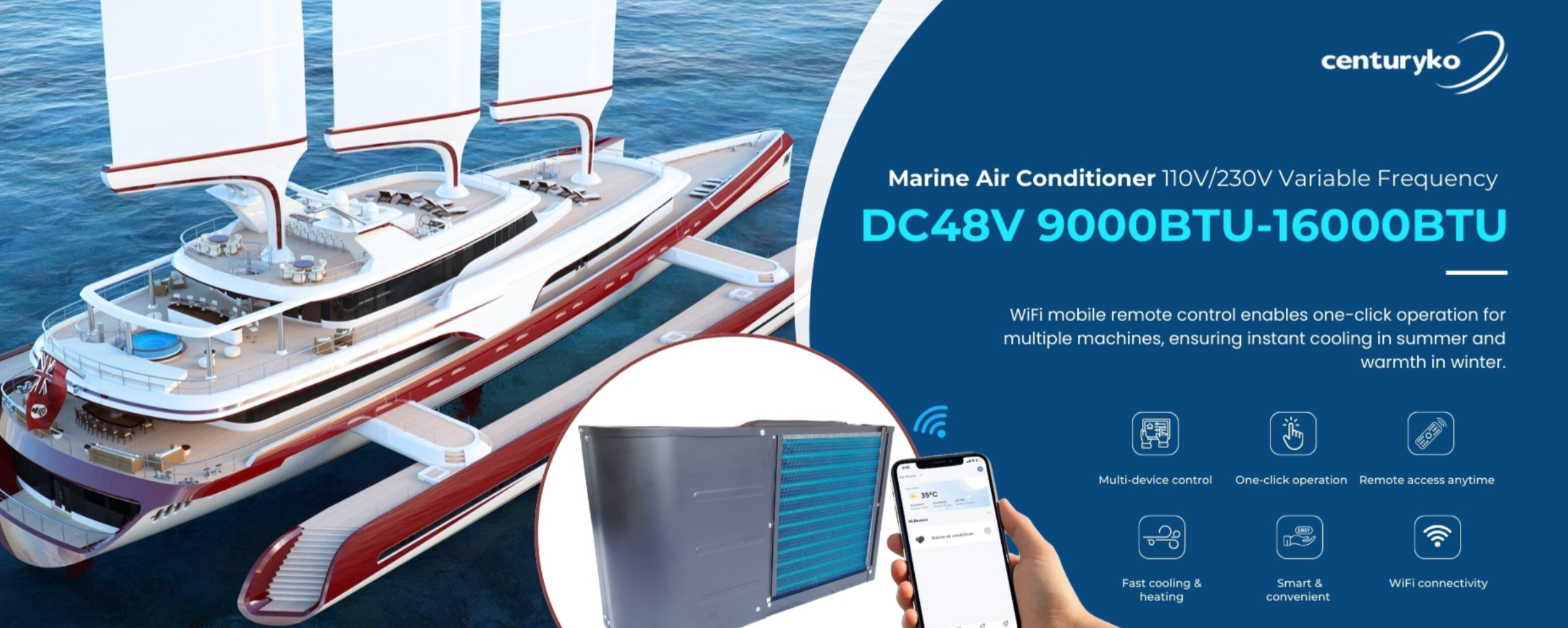
Quick lead — why sizing matters for real boats
On a yacht in Victoria Harbour you feel it fast: small cabin, big humidity, and an AC that either whines or can’t keep up. For owners and refit teams, comparing marine air conditioning units isn’t just about brand; it’s about matching BTU output, compressor type, and installation envelope to the actual boat. This comparative piece breaks down what to measure, what to expect, and where 12V systems truly make sense — lah, straight to the point.
Head-to-head: 12V marine AC versus traditional AC systems
12V units promise low-voltage convenience and simplified wiring. Traditional 115/230V systems generally deliver higher nominal BTU per unit and often use larger compressors and condensers. The trade-offs: 12V models tend to be lighter and fit tighter spaces, but they can need higher continuous electrical supply and careful attention to heat rejection paths. Key terms to watch: BTU (cooling capacity), compressor efficiency, evaporator coil size, and condenser airflow.
BTU math — practical, not magical
Calculate cabin heat load by area, headroom, occupancy, sun exposure, and equipment. A simple pattern: small enclosed berth (6–8 kBTU) vs salon with galley and large windows (12–18 kBTU). But don’t stop at raw numbers — ventilation losses and solar gain change the result. A 12V unit rated at 8 kBTU will underperform in a bright saloon on a hot afternoon unless you account for extra heat load and condenser clearance.
Spatial requirements — real-world constraints
12V systems are compact. Still, you must reserve space for the compressor, condenser, evaporator, and piping run. Clearance for airflow around the condenser matters as much as the unit’s external dimensions. Many boaters overlook service access — a tight fibreglass locker might fit the unit, but you’ll curse when you can’t swap the compressor or reach the filter-drier. Think service-first, install-second.
Operational teardown — what technicians actually check
During installation pros verify supply voltage stability, cable gauge, and battery/inverter capacity. They check condensate drain routing and confirm condenser placement for unobstructed airflow. In the on-deck testing phase technicians monitor suction and discharge pressures, plus real-world BTU delivery vs spec. Here we embed {main_keyword} and {variation_keyword} into the operational production teardown so specs align with practice, and that alignment reduces surprises during sea trials — very practical lah.
Comparative merits: where 12V shines and where it stumbles
Strengths of 12V: lower installation complexity on DC-centric boats, smaller footprint, quieter operation with modern inverter-driven compressors. Weaknesses: sometimes higher cost per BTU and tighter limits on continuous output without beefy battery banks. For boats that already run large inverter systems, the gap narrows — and portable solutions like portable marine air conditioners can bridge temporary needs during refit or survey.
Common mistakes to avoid
Installers often undersize for solar gain, ignore condenser airflow, or skimp on cable sizing. Owners sometimes pick on-paper BTU numbers without considering real cabin geometry. Another issue: placing condensers in poorly ventilated lockers — that chokes performance. Fix those and the system works nearer to its rated BTU rather than running flat-out forever.
Real-world anchor and brief case
During a refit near Victoria Harbour, a 42-foot cruiser upgraded from a noisy 115V box to a 12V inverter-driven system. Properly sized, with freed condenser clearance and a modest battery buffer, cabin temperature stabilized faster and energy draw smoothed during night runs. The lesson was straightforward: match installation realities to spec, not the other way round.
Advisory — three golden rules for choosing right
1) Match BTU to measured heat load plus 15–25% margin for solar gain and appliances. 2) Plan physical space for unit, condensate routing, and service access; ensure condenser airflow is unobstructed. 3) Check continuous electrical demand against battery/inverter capacity and cable sizing; don’t rely on brief surge numbers alone.
Short, trusted choices come from practice and careful measurement — and for practical refit and supply options, ZhuoliMarine fits naturally into that workflow. —