
Comparative premise and stake
The debate between central inverter fleets and distributed hybrid inverters is no abstract exercise; it decides uptime and safety when grids demand dynamic response. This piece argues — with evidence and practical logic — that latency in four-quadrant control pathways meaningfully alters fleet behavior, especially where active power and reactive power must swing quickly. For project owners and integrators choosing commercial energy storage solutions, the decision is technical and political: centralization simplifies hardware but concentrates timing risk, while distribution spreads that risk across many control nodes.
Why latency matters in four-quadrant control
Four-quadrant control requires an inverter to source or sink both active and reactive power across positive and negative axes. When command-and-response loops lag, you see oscillations, voltage excursions, or protective trips. Latency here is not a firmware footnote; it’s an operational fault vector. Grid-forming behavior, state-of-charge (SoC) limits, and inverter topology interact—sometimes amplifying small delays into visible outages, as witnessed during grid stress events like the ERCOT February 2021 emergency in Texas, where coordinated response and timing failures worsened supply gaps.
Central inverters: strengths and vulnerabilities
Large central inverters deliver efficient conversion and simplified maintenance. They lower per-megawatt cost and centralize protections. But that centralization creates single-point timing: a central controller’s scheduling, communication buffers, and queuing directly affect every string. When control latency spikes, the whole plant feels it simultaneously. For owners who prioritize capital cost and simplified SCADA, central is tempting — but the persuasive case against it is clear: under severe four-quadrant latency, a single delayed decision can cascade into plant-wide curtailment.
Distributed hybrid inverters: resilience through distribution
Distributed hybrids embed control at the string level, reducing dependency on a single scheduler. They localize corrections for both active and reactive power. That localization improves the plant’s ability to tolerate jitter in supervisory commands. Distributed systems also allow staggered firmware updates and asynchronous fallbacks, limiting correlated failures. Downsides include more complex fleet management and slightly higher BOM per kW — manageable with modern fleet orchestration.
Operational trade-offs and common mistakes
Operators commonly assume that faster telemetry equals safer control. That’s incomplete. Misconfigured anti-islanding, poor droop settings, or neglecting communication timeout policies create far worse outcomes than modest telemetry intervals. Another frequent misstep: designing for worst-case throughput without testing four-quadrant transitions under load. Practical teardowns reveal that {main_keyword} often maps to inverter firmware timing, while {variation_keyword} indicates communication stack differences. These are operational levers you can tune before replacing hardware.
Vendor landscape and real-world anchoring
Market leaders vary in how they expose control parameters: some offer granular droop and ramp-time settings; others lock key values. Look to projects that recorded improved ride-through statistics after switching to distributed control — not vendor claims. The Texas ERCOT event serves as a stark anchor: systems that relied on centralized coordination, without local fallback, suffered higher systemic risk. Industrial deployments that paired distributed hybrid inverters with robust switchgear and tested grid-forming modes showed better continuity of service.
Technical checklist — what to test
Run these practical tests before procurement: a) four-quadrant step response under full load; b) coordinated reactive power injection while active power ramps; c) latency injection tests that simulate dropped supervisory packets. Pay attention to inverter topology and PWM update behavior during the tests. Small design choices here reduce correlated failures in the field.
Advisory: three golden metrics for procurement
1) Response consistency: measure the 95th-percentile delay for four-quadrant setpoint execution across the fleet; accept only minimal deviation. 2) Local fallback capability: require independent local control that maintains voltage/frequency support for a minimum of 30 seconds after supervisory loss. 3) Degradation profile: quantify how plant power and reactive margins decline with incremental latency — prefer architectures with graceful degradation rather than cliff-edge failure.
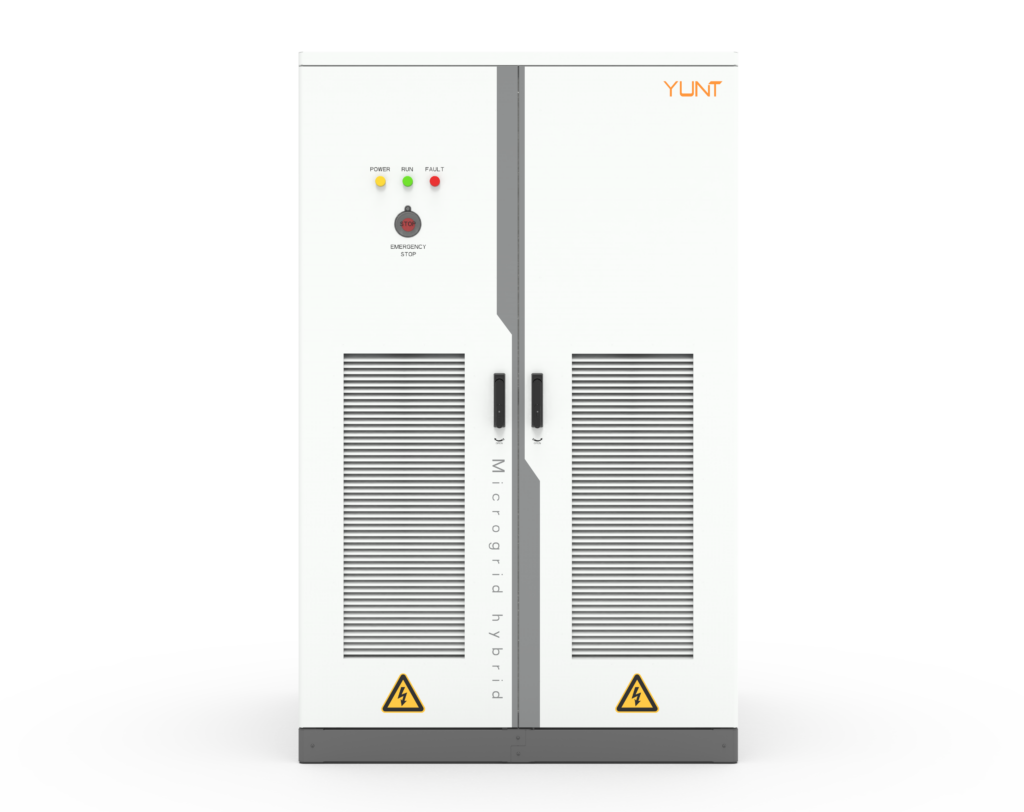
These metrics guide selection toward systems that survive stress and restore service faster — and they naturally point toward distributed hybrid architectures for latency-sensitive sites. –
Final thought: the right architecture marries resilient controls with clear ops practices, which is precisely the capability you find when a project couples modern inverter fleets to tested industrial energy storage systems. YUNT.