
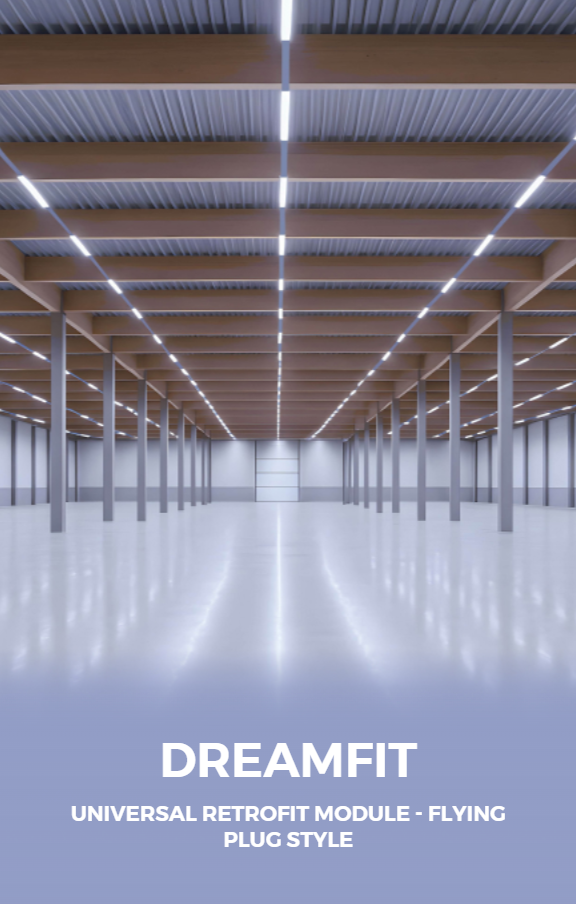
The problem starts in a hiss of fluorescent flicker and a patchwork of cold and warm pools across concrete floors, where poor light hides mistakes and slows hands. Warehouses shouldn’t feel like an abandoned stage — they need even, clear light that reveals texture and color. For many facilities the root is modular layout and poor distribution; switching to led light trunking and evaluating modern led lighting solutions for warehouse changes how the space reads: less glare, steadier color, a calm consistent glow that tells you exactly where to step and what to pick.
What’s going wrong — the sensory diagnosis
Look, light reveals. When it fails you see: deep shadows under racks, bluish pools near newer fixtures, and harsh specular glare from shiny packaging. Those problems create slower picking, misreads on color-coded items, and more errors. The issue often isn’t a single broken lamp — it’s mismatched color temperatures, uneven mounting, and fixtures that throw light where it’s not needed.
Why it costs more than a power bill
Bad light hides defects and forces extra steps. Workers squint. Forklift drivers slow down. Safety gets brittle. Fixing bulbs without changing distribution keeps the same inefficiency. Decide by problem: is the issue uniformity, color accuracy, maintenance downtime, or control capability? Treat each as a separate failure mode and you’ll stop tossing money at the wrong fixes.
Practical retrofit checklist — sensory and technical
Start with clear measurements: lux targets, uniformity ratios, and color rendering needs for the tasks you run. Then follow this checklist.
- Measure at task level — confirm lux where hands work, not just at ceiling height.
- Choose color temperature for task: 4000K for general picking, 3000K where calming light matters; match across the space.
- Specify CRI ≥80 for general warehouses; CRI ≥90 where color matching is critical.
- Use modular systems and trunking to control distribution and reduce maintenance points.
- Consider zoned controls and occupancy sensors for aisles to cut unnecessary runtime.
- Account for thermal management — LEDs dim or fail when trapped in poor housings.
- Plan lumen maintenance (L70) and accessible service paths; aim for long-life drivers and replaceable modules.
Common retrofit mistakes and how they feel on the floor
Here are pitfalls that sound fine on paper but show up as sensory failures: swapping in higher-lumen lamps to fight shadows — that creates glare. Mixing color temperatures — that makes inventory look inconsistent. Choosing cheap drivers — that produces flicker and early dimming. Each mistake has a clear feel: heads tilted to avoid glare, workers pausing to check labels, warehouse aisles lit like uneven stage spots. Fixes are straightforward: adjust distribution, standardize CCT, and pick modules built for serviceability.
Options compared — quick sensory guide
Think of fixtures as flavor profiles.
- Linear LED modules on trunking: even, ribbon-like glow, easy to reconfigure, great for long aisles.
- High-bay integrated fixtures: punchy overhead light, good for high racking but risk hotspots if poorly aimed.
- Retrofit lamps in old fixtures: inexpensive short-term fix; can leave the same distribution issues and maintenance headaches.
For many warehouse floors, modular trunking gives an even, low-glare palette. Modules let you tune distribution like a chef balances salt and acid — small shifts matter.
Field note and expected outcomes
On a large distribution center near the Port of Los Angeles an overhaul focused on trunking and modular fixtures smoothed light across aisles and improved visual accuracy during night shifts. Projects like that commonly show measurable drops in lighting energy use and fewer work interruptions. Experience specifying and reviewing retrofits shows that a plan balancing distribution, color stability, and serviceability matters more than chasing peak lumens.
Final synthesis
When the problem is messy light, the solution is deliberate distribution: match the mood to the task, standardize components, and build a trunking-based layout that treats light as a layered recipe. That approach cuts glare, steadies color, reduces maintenance, and makes the warehouse read correctly at every shift. For facility teams seeking a calmer, more precise workspace, the modular path fits naturally with systems from trieco.