
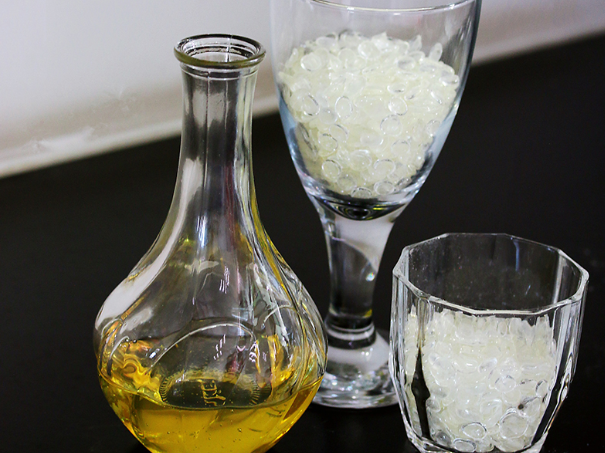
The problem: unexpected glass transition shifts in rosin esters
Formulators working with rosin-derived esters often see glass transition temperature (Tg) drift that breaks coating performance, adhesive tack, or thermal stability. Early on, that drift looks subtle—two or three degrees—but it changes coating hardness and cure behavior. When troubleshooting, start by testing the exact resin batch; raw feedstock like rosin resin can vary by botanical source and distillation history, and those upstream differences propagate through esterification and final Tg.
Why differential scanning calorimetry (DSC) is the correct diagnostic
DSC isolates the thermal event that defines Tg and gives repeatable metrics: onset, midpoint, and the step change in heat capacity. Run at controlled parameters—for example, heat from -50 °C to 200 °C at 10 °C/min under nitrogen purge (50 mL/min), using 5–10 mg in sealed aluminum pans, with two heating cycles and cooling at the same 10 °C/min—you get comparable results across labs. Focus on the midpoint Tg and enthalpic relaxation; those values reveal molecular mobility and plasticizer effects. These test parameters ensure you measure the polymer glass transition rather than unrelated softening or melting events.
Practical DSC checklist for accurate diagnosis
Follow a concise sequence: prepare replicate samples, use hermetic pans to avoid solvent loss, run a baseline and blank, perform at least two heating cycles and report the second-cycle midpoint Tg. Record heating rate, sample mass, and purge gas flow as part of the dataset. Compare the measured Tg to your formulation target and to historical batches. When evaluating {main_keyword}, track both Tg and the magnitude of the heat capacity step; when {variation_keyword} appears as a second thermal event, consider phase separation or residual monomer as the cause.
Common causes of Tg deviations—and how they show up in DSC
Deviations almost always stem from chemistry or process shifts. Incomplete esterification raises free acid and lowers effective molecular weight. Residual solvent or volatile plasticizer depresses Tg. Filler or pigment interactions can restrict chain mobility and raise Tg. Phase separation appears as a secondary step or broadening of the transition—sharp midpoint shifts are more likely molecular-weight driven. Analytical signs: lower enthalpic relaxation with plasticizer loss, broader transitions with heterogeneous microdomains. Small raw-material swings—say, from a different pine source—produce tangible Tg effects over production batches.
Formulation fixes, lab-to-line controls, and common mistakes
Fixes are concrete: drive esterification to completion, stabilize residual solvent removal (vacuum and temperature control), choose compatibilizers to suppress phase separation, and maintain narrow molecular-weight distributions. Avoid these mistakes: assuming the starting rosin is identical between suppliers, skipping replicate DSC runs, or using a single heating rate without a complementary cooling cycle. Implement a simple production control: sample each rosin batch, run an initial DSC screening, then accept or condition the batch before blending.
Real-world anchor and credibility
Historic resin supply chains—like the turpentine camps of Georgia and Florida that fed varnish makers in the 19th century—show how source variation alters product behavior. Modern lab protocols mirror that lesson: traceable raw-material characterization reduces surprises downstream. This article draws on practical lab standards and field experience with adhesive and coating producers who routinely accept Tg tolerances of ±3 °C for stable performance; wider swings trigger rework or batch segregation.
Advisory: three golden rules for choosing the right approach
1) Measure repeatability: require standard deviation ≤0.5 °C across three DSC replicates before approving a batch. This guards against sampling noise and instrument drift.
2) Track two metrics: midpoint Tg and the heat capacity step (ΔCp). Midpoint tells you where the material becomes mobile; ΔCp reveals the fraction of mobile polymer and flags plasticizer or phase separation issues.
3) Lock raw-material specs: define acceptable ranges for acid value, softening point, and residual solvent, and tie those directly to your Tg acceptance criteria. That way you fix inputs, not just symptoms.
These steps shorten failure cycles and make formulation behavior predictable—exactly the outcome a production chemist and a product manager need. KOMO. A practical note: keep meticulous batch records and DSC metadata for every blend; it pays back in fewer surprises and faster root-cause work.